Saigon Full Day Tour: Colonial Landmarks, War Museum & Cholon Chinatown
Saigon Full Day Tour: Colonial Landmarks, War Museum & Cholon Chinatown
Ho Chi Minh
What are the highlights of this tour?
- Explore both sides of Saigon in one day — French colonial District 1 in the morning, the vibrant Chinese district of Cholon in the afternoon.
- Walk the halls of Independence Palace, where a North Vietnamese tank ended the Vietnam War on April 30, 1975.
- Visit the War Remnants Museum — the most documented account of the American War told from the Vietnamese perspective.
- Discover Cholon’s Thien Hau Pagoda, Binh Tay Market, and the Ten Thousand Buddhas Pagoda — all within Saigon’s oldest neighbourhood.
- A local guide connects the colonial, wartime, and Chinese cultural threads that together make Saigon one of Asia’s most layered cities.
About
Saigon is not one city — it’s several, layered on top of each other. The French built their colonial capital in what is now District 1. The Chinese merchants who arrived in the 18th and 19th centuries built their own world in Cholon, a few kilometres west. This full-day tour covers both, moving from the grand colonial facades of the morning into the incense-thick streets of Chinatown in the afternoon.
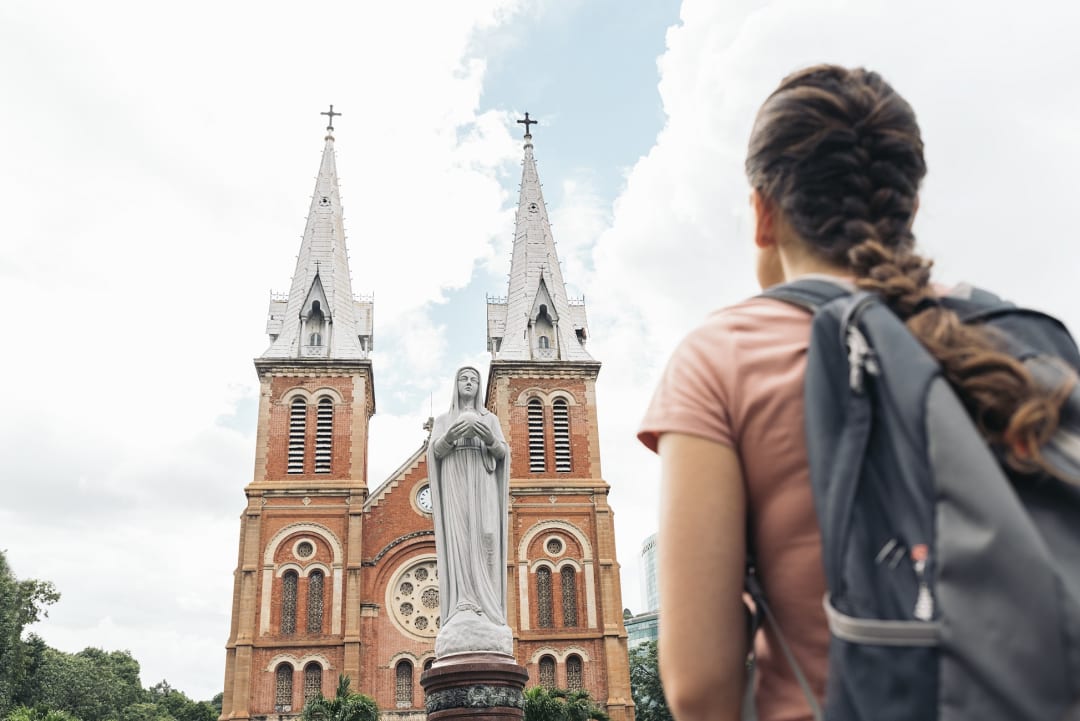
Your morning starts with hotel pick-up and heads to Notre Dame Cathedral and the Saigon Central Post Office — two of the French colonial era’s most enduring contributions to the city’s skyline. The Post Office interior, with its Eiffel-designed iron arches and vaulted ceilings, is one of the most beautiful rooms in Vietnam and still processes mail every day.
At Independence Palace, the morning gets heavier. This is the building where the Vietnam War ended — where a North Vietnamese tank crashed through the gates on April 30, 1975. The war rooms, underground bunkers, and rooftop helicopter pad are preserved almost exactly as they were that day, and walking through them with a local guide gives the building a context that no guidebook can replicate. The War Remnants Museum follows: confronting, meticulously documented, and essential for anyone who wants to understand Vietnam beyond its beaches and ancient towns.
A stop at the Phuongnam Lacquer Workshop — where traditional Vietnamese lacquerware is still produced by hand — offers a quieter, craft-focused interlude before lunch.
The afternoon shifts west into Cholon, the largest Chinatown in Southeast Asia. Thien Hau Pagoda is the neighbourhood’s spiritual heart: smoke-blackened ceilings, enormous spiral incense coils hanging from the rafters, and the sea goddess Mazu worshipped here by the Cantonese community since the 1700s. Binh Tay Market — the original wholesale market of Cholon — is busier, louder, and considerably more interesting than the tourist-facing markets of District 1. The tour closes at the Ten Thousand Buddhas Pagoda, where rows of small Buddha figures line every wall and alcove in a display that is simultaneously solemn and visually extraordinary.